

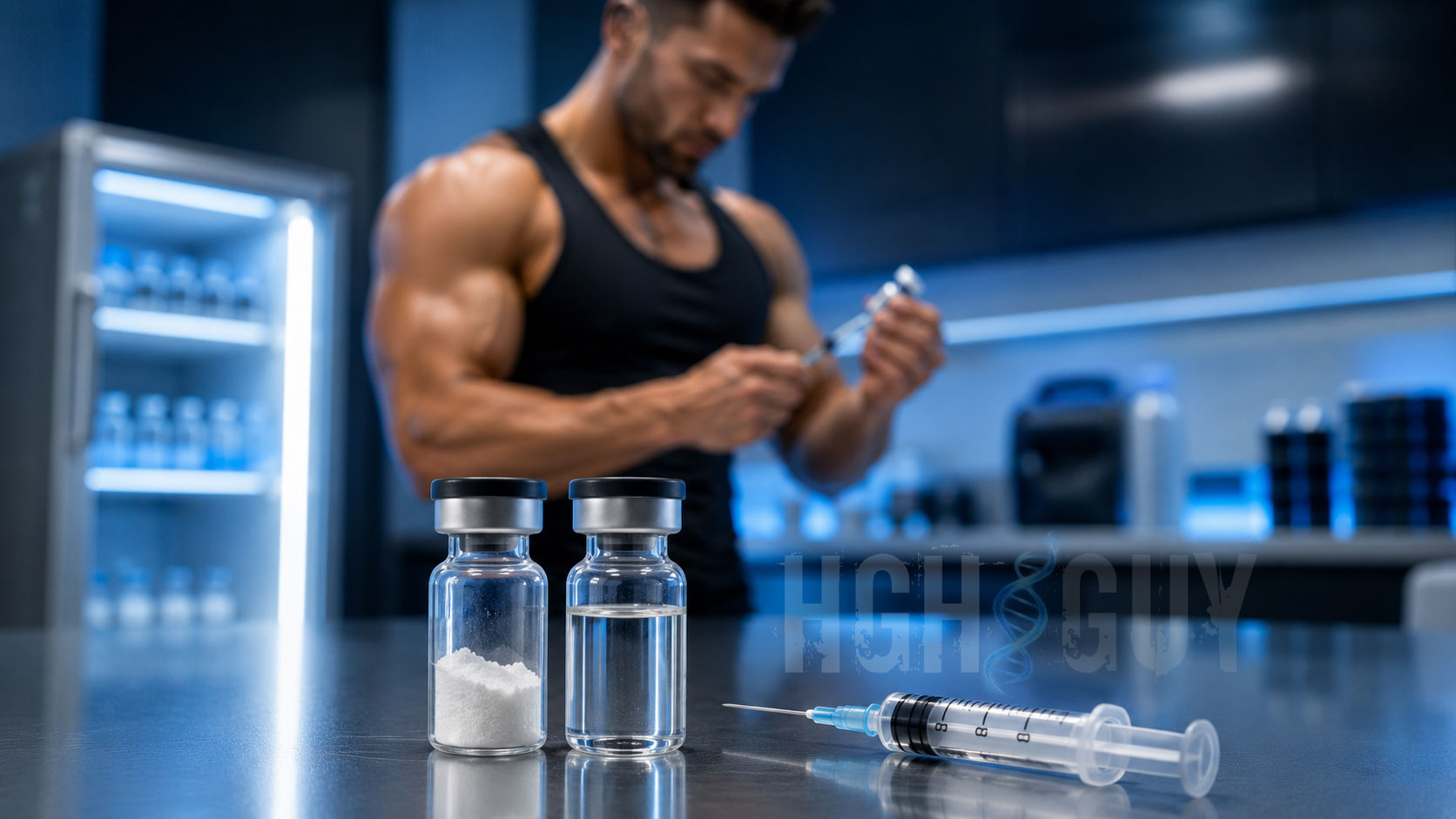
Some human growth hormone products are supplied as ready-to-use solutions, while others come as a dry lyophilized powder that must be reconstituted with a suitable diluent before use. Because HGH is a protein-based medication, the way it is mixed, stored and handled can affect the stability and quality of the final solution.
There is no single reconstitution or storage rule that applies to every HGH product. Different somatropin formulations can use different diluents, concentrations, devices and storage periods. Pharmaceutical products should therefore always be handled according to the manufacturer’s instructions, pharmacist guidance and the directions provided with the specific medication.
Understanding the general principles can still be useful. Knowing what reconstitution means, why HGH is often refrigerated, why vigorous shaking is discouraged and how concentration changes with the amount of diluent added can make product instructions much easier to understand.
What Does Reconstituting HGH Mean?
Reconstitution simply means adding a liquid diluent to a medication supplied as a dry powder so that it becomes a liquid solution.
Some forms of HGH are manufactured as a lyophilized powder. Lyophilization, often called freeze-drying, removes water from the product while helping preserve the protein during storage. The dry HGH remains in the vial until an appropriate diluent is added.
Once the liquid is added, the amount of HGH in the vial has not changed. What changes is its concentration, because the same quantity of HGH is now distributed throughout a particular volume of liquid.
For example, adding more diluent produces a less concentrated solution, while adding less produces a more concentrated solution. This concentration relationship is what our HGH Reconstitution Calculator is designed to calculate.
Does All HGH Need to Be Reconstituted?
No. One of the most important things to understand is that not every pharmaceutical HGH product comes as a dry powder.
Some somatropin products are supplied as pre-filled pens or liquid cartridges that already contain a prepared solution. These products do not require the user to add bacteriostatic water or another diluent before use.
Other HGH products are supplied as lyophilized powder and must be reconstituted according to their specific instructions. Health Canada currently lists both types of somatropin products, including ready-to-use solutions and products described as powder for solution.
This is why advice such as “mix every HGH vial with the same amount of bacteriostatic water” is not reliable. The first question should always be what specific product and formulation is being used.
What Liquid Is Used to Reconstitute HGH?
The appropriate diluent depends on the specific HGH product.
Some lyophilized somatropin products permit bacteriostatic water for injection, while others may be supplied with their own proprietary diluent or require another manufacturer-specified solution. Certain products may also permit sterile water for injection under particular circumstances.
These liquids are not automatically interchangeable. Bacteriostatic water contains a preservative, typically benzyl alcohol, while sterile water for injection does not contain the same antimicrobial preservative.
That difference can dramatically affect how long a reconstituted vial can be stored. For example, the Canadian product monograph for one lyophilized Saizen formulation permits bacteriostatic water and allows refrigerated storage after reconstitution, while the same product reconstituted with sterile Water for Injection is intended to be used within a much shorter period.
The safest rule is therefore simple: use only a diluent permitted for the specific HGH product rather than assuming one type of water is appropriate for every vial.
Bacteriostatic Water vs Sterile Water for HGH
Bacteriostatic water and sterile water are both sterile products intended for medical use, but they are not identical.
Bacteriostatic Water for Injection normally contains benzyl alcohol as a preservative. The preservative helps inhibit bacterial growth after the vial has been entered, which can make it suitable for certain multidose injectable medications when the manufacturer permits its use.
Sterile Water for Injection does not contain that same antimicrobial preservative. As a result, a medication prepared with sterile water may have a much shorter allowable storage period once mixed.
This is one reason generic online claims such as “reconstituted HGH is always good for 28 days” should be treated cautiously. The correct storage period depends on the actual HGH product, diluent and manufacturer instructions.
How Is HGH Reconstituted?
The exact procedure should come from the medication’s product instructions or pharmacist. In general, reconstitution involves introducing the approved diluent into the vial containing the lyophilized HGH while maintaining sterile handling.
Pharmaceutical instructions commonly emphasize cleaning the vial stopper before it is punctured and adding the liquid without unnecessarily agitating the protein. Some product monographs instruct the user to direct the liquid toward the inside wall of the vial and then gently rotate or swirl the vial until the powder has dissolved.
What should generally be avoided is forceful shaking. HGH is a protein, and manufacturer instructions for several somatropin products specifically caution against vigorous shaking.
If the product does not dissolve as expected, contains visible particles or appears abnormal after preparation, the medication should not simply be assumed to be usable. The product instructions or pharmacist should be consulted.
Should You Shake HGH After Mixing?
Generally, no. HGH should not be vigorously shaken unless the manufacturer’s instructions specifically say otherwise.
Somatropin is a protein molecule, and protein-based medications can be more sensitive to mechanical stress than ordinary small-molecule drugs. Excessive agitation can promote protein aggregation or other physical changes in a solution.
Some product instructions instead recommend a gentle swirling or rotary motion when reconstitution is required. The goal is simply to allow the powder to dissolve without aggressively foaming or agitating the solution.
Ready-to-use HGH products may also carry instructions not to shake them vigorously. The current Canadian Norditropin FlexPro monograph, for example, specifically states that the product should not be shaken vigorously at any time.
How Much Water Should Be Added to HGH?
There is no universally correct volume because the appropriate amount depends on the product and desired prescribed concentration.
The manufacturer’s instructions should establish the acceptable reconstitution range or provide the diluent in the correct quantity. Changing the volume changes the concentration of HGH in every millilitre of the resulting solution.
This is an important distinction because vial strength and solution concentration are not the same thing. A vial can contain the same total amount of HGH regardless of whether it is mixed into a smaller or larger liquid volume.
Our HGH Reconstitution Calculator can calculate the resulting concentration when you enter the vial strength and the reconstitution volume specified for your product. It is intended as a concentration and measurement tool, not as a recommendation for how much HGH someone should use or what volume should be chosen for a particular medication.
HGH Concentration After Reconstitution
The basic concentration calculation is straightforward:
Total amount of HGH ÷ total liquid volume = HGH concentration per millilitre
If the same vial is reconstituted with a larger volume, each millilitre contains less HGH. If it is reconstituted with a smaller volume, each millilitre contains more HGH.
This is why knowing only the number printed on the vial is not enough to determine the concentration of a reconstituted solution. You also need to know how much liquid was actually added.
The HGH reconstitution calculator handles this calculation automatically and can make it easier to visualize how different manufacturer-approved reconstitution volumes affect concentration.
Does HGH Need to Be Refrigerated?
Many HGH products require refrigeration, but again, the exact rule depends on the formulation.
A common pharmaceutical storage range for somatropin is approximately 2°C to 8°C, which is standard refrigerator temperature. Products stored this way generally should not be frozen or placed directly against a refrigerator cooling element.
However, not every product has identical requirements. Some lyophilized HGH products can be stored at room temperature before they are reconstituted, while certain ready-to-use pens must remain refrigerated before first use.
Some products even allow limited room-temperature storage after they have been opened. For example, current Canadian instructions for Norditropin FlexPro permit refrigerated storage after first use for one period or storage below a specified room temperature for a shorter period.
The correct answer to “Does HGH need to be refrigerated?” is therefore usually, but check the exact product instructions.
Does HGH Need Refrigeration After Reconstitution?
Reconstituted lyophilized HGH commonly requires refrigeration.
Once water has been introduced into a freeze-dried product, the stability characteristics change. The reconstituted solution generally has a much shorter usable life than the unopened dry vial.
Product-specific differences remain important. The Canadian Saizen monograph, for example, permits refrigerated storage for up to 14 days for one lyophilized formulation when it is prepared with bacteriostatic water. The same formulation prepared with preservative-free Water for Injection has a far shorter usable period.
This is why the diluent used should be recorded along with the date a vial was reconstituted. Simply remembering when the original dry vial was opened does not provide enough information.
How Long Does HGH Last After Mixing?
There is no universal answer.
The shelf life of reconstituted HGH depends on the formulation, diluent, preservative system, storage temperature and manufacturer stability data. One product may be intended for use over multiple days after mixing, while another combination of product and diluent may need to be used almost immediately.
A commonly repeated online rule such as 14 days, 21 days or 28 days should therefore not be applied blindly to every HGH vial.
For prescription HGH, the manufacturer’s product monograph or pharmacist should be treated as the primary source for how long the prepared medication remains usable. If the product comes from outside the regulated pharmaceutical supply chain, an advertised storage period may not be supported by the same type of formal stability testing.
Can HGH Be Frozen?
HGH products that specify refrigerated storage generally state that they should not be frozen.
Freezing a protein medication can potentially affect the physical stability of the formulation. If a pharmaceutical HGH product has accidentally frozen, simply allowing it to thaw does not necessarily mean it remains suitable for use.
Refrigerators can also develop localized cold spots. Storing HGH directly beside a cooling element or against the rear wall of some refrigerators can expose it to temperatures lower than the general refrigerator setting.
For that reason, manufacturer instructions often specifically warn against storing HGH near a cooling element even when refrigeration itself is required.
What Temperature Should HGH Be Stored At?
For many pharmaceutical HGH products, refrigerated storage means 2°C to 8°C. This is the same general range used for many refrigerated medications.
A refrigerator thermometer can be useful when medications requiring refrigeration are stored at home because the temperature displayed on the refrigerator control is not always the temperature experienced in every part of the compartment.
Products should also be protected from excessive heat. Leaving HGH in a hot vehicle, direct sunlight or other high-temperature environment can expose the medication to conditions outside the manufacturer’s tested storage range.
If a pharmaceutical HGH product has been exposed to temperatures outside its labelled limits for an unknown period, the manufacturer or pharmacist is the best source for determining whether it can still be used.
Does Light Affect HGH?
Some HGH formulations are specifically instructed to be protected from direct light.
Keeping the medication in its original packaging while stored can provide both physical protection and protection from unnecessary light exposure. It also keeps the product label, expiration date, lot information and storage instructions with the medication.
There is little benefit to repeatedly removing a vial or pen from its packaging simply to inspect it when it is not being used. Stable, appropriate storage is preferable to frequent handling and temperature changes.
The exact light-storage requirements should still come from the product’s instructions because formulations can differ.
What If HGH Gets Warm During Shipping?
Temporary temperature excursions do not have one universal answer.
Some pharmaceutical somatropin products have manufacturer stability data allowing specific periods outside the refrigerator, while other formulations have more restrictive requirements. Whether a shipment remains acceptable can therefore depend on how warm it became, how long it remained at that temperature and whether the product had already been opened or reconstituted.
This is particularly relevant when evaluating an online HGH seller. Shipping information should explain where the product is being shipped from and how temperature-sensitive products are handled during transit.
However, packaging that feels cool on arrival is not itself proof that the medication remained within an appropriate temperature range throughout transportation. Pharmaceutical cold-chain systems use validated shipping and storage procedures for precisely this reason.
What Should Reconstituted HGH Look Like?
Many pharmaceutical somatropin solutions are intended to appear clear after proper preparation, although the exact appearance should always be checked against the specific product instructions.
Visible particles, unexpected discolouration or an abnormal appearance are reasons not to assume that a prepared medication is suitable for injection. Product monographs commonly instruct users to visually inspect parenteral medications before administration.
Foaming immediately after excessive agitation can also make a solution appear different from normal. This is another reason vigorous shaking is generally discouraged.
When there is uncertainty about the appearance of a prescribed HGH product, a pharmacist or manufacturer can provide product-specific guidance.
Does Reconstituted HGH Expire?
Yes. Reconstitution creates a new and usually much shorter in-use storage period.
The printed expiration date on an unopened vial refers to the product stored under its specified unopened conditions. It does not mean that a reconstituted vial remains usable until that same date.
Once a product is mixed, the manufacturer may specify a limited period such as hours, days or weeks depending on the formulation and diluent. After that period, any remaining medication is generally discarded even if the liquid still looks normal.
Writing the reconstitution date on or near the vial can make this easier to track.
Can You Use HGH After the Recommended Storage Period?
The fact that a medication still looks clear does not establish that it remains within its validated stability period.
Manufacturer storage limits are based on stability, sterility and product-quality data rather than visible appearance alone. Protein degradation and loss of potency are not necessarily visible to the eye.
For prescription HGH, the labelled storage period should therefore be followed rather than extending use based solely on appearance.
If a vial has been left unrefrigerated, frozen or stored beyond its recommended period, a pharmacist or manufacturer can advise whether the specific exposure falls within validated stability data.
Why Sterile Handling Matters
Reconstitution introduces another opportunity for contamination because a needle must enter the vial and liquid is being added to a previously dry product.
Hands, vial stoppers, syringes and the surrounding environment can all carry microorganisms. Using sterile equipment and following the product’s preparation instructions reduces the chance of introducing contamination into an injectable solution.
Multidose products require particular care because the vial or cartridge may be accessed repeatedly over time. A preservative such as benzyl alcohol can reduce bacterial growth in products designed to use it, but it does not make poor handling practices safe.
A solution that may be contaminated should not be used simply because it has not reached the end of its labelled storage period.
HGH Reconstitution and the Reconstitution Calculator
Reconstitution math becomes much easier once three pieces of information are understood: the amount of HGH in the vial, the amount of diluent added and the resulting concentration.
Our HGH Reconstitution Calculator performs that concentration calculation automatically. It can help translate a manufacturer-directed reconstitution volume into an easier-to-understand concentration without repeatedly working through the arithmetic manually.
The calculator does not determine whether a particular diluent is appropriate, how much diluent should be used for a specific prescription product or what HGH dose someone should take. Those decisions come from the product instructions and the healthcare professional supervising treatment.
Used together, the calculator and this guide provide two different pieces of information: this article explains the general handling and storage principles, while the calculator handles the concentration math.
Common HGH Reconstitution and Storage Mistakes
One of the most common mistakes is assuming that every HGH vial should be prepared in exactly the same way. Pharmaceutical somatropin products differ significantly, and some require no reconstitution at all.
Another mistake is assuming that bacteriostatic water and sterile water produce the same storage period. They do not necessarily do so because the presence or absence of a preservative can change the manufacturer’s validated in-use period.
Vigorous shaking, freezing the medication, storing it directly against a refrigerator cooling element and ignoring the date of reconstitution are other avoidable handling problems.
Perhaps the biggest mistake is relying on a generic internet storage rule instead of identifying the actual HGH formulation. With a biological medication, the product-specific instructions matter.
The Bottom Line
HGH reconstitution is the process of converting freeze-dried human growth hormone into a liquid solution using an appropriate diluent. Not every HGH product requires this step, because many modern somatropin products are supplied as ready-to-use liquid pens or cartridges.
For products that do require reconstitution, there is no universal amount of diluent, storage period or approved reconstitution liquid. Bacteriostatic water may be appropriate for some products, while others use a manufacturer-supplied diluent or another specified solution. The manufacturer’s instructions should always take priority.
Reconstituted HGH is commonly refrigerated, vigorous shaking is generally avoided and freezing should be prevented. The usable life after mixing depends on the specific product and diluent rather than a single rule that applies to all HGH.
Our HGH Reconstitution Calculator can help with the concentration math once the appropriate vial strength and reconstitution volume are known. It should be used alongside the product instructions rather than as a replacement for them.
Medical Disclaimer
This article is for educational and informational purposes only and is not medical advice or a substitute for the instructions supplied with a prescription medication. Human growth hormone (HGH/somatropin) is a prescription medication in Canada, and reconstitution, storage and handling requirements vary by product. Always follow the manufacturer’s product information and guidance from your pharmacist or prescribing healthcare professional.